

Southeast Alabama — Wiregrass Region

Professional
Drum Mulching Services

Clear overgrown land without burning, hauling, or tearing up the soil. Hyde’s Construction provides owner-operated drum mulching services across Coffee County, Dale County, Houston County, and the surrounding Wiregrass region of Southeast Alabama.

Why Hyde's Construction
Licensed & Insured
Full coverage on every job site
Owner Operated
DJ Hyde runs every project
Based in Ariton, AL
Serving the Wiregrass region
Free On-Site Estimates
No obligation, same-day response
Call DJ directly(334) 432-1473

Mon–Fri 7am–5pm · Fast response guaranteed

Service Overview

What Is Drum Mulching?

Drum mulching is a land-clearing method that uses a high-powered rotating drum covered in fixed carbide teeth to grind standing trees, brush, and undergrowth directly into mulch at ground level. The attachment is mounted on a tracked carrier — typically a compact track loader or skid steer — and processes vegetation in place without pushing, piling, or removing material from the site.

The result is a cleared surface covered in a layer of organic mulch rather than exposed bare soil. That mulch layer serves a practical purpose: it suppresses weed and brush regrowth, reduces erosion by protecting the soil surface from rain impact, retains moisture in the root zone, and breaks down over time to return nutrients to the ground. For landowners who need vegetation removed but want to preserve the integrity of the soil underneath, drum mulching is one of the most efficient methods available.

Unlike traditional push-and-pile clearing — where a dozer knocks trees over, pushes debris into a burn pile, and leaves the site stripped to bare dirt — drum mulching keeps the topsoil intact and eliminates the need for debris hauling, open burning, or post-clearing erosion control measures. That makes it faster, cleaner, and in many cases significantly less expensive than conventional approaches, especially on properties with moderate brush density and small to mid-size trees.

Hyde’s Construction provides drum mulching services across Southeast Alabama, including Enterprise, Ozark, Dothan, Troy, Eufaula, and surrounding communities. DJ Hyde is owner-operated — he runs the equipment himself and handles the project from site visit through final walkthrough.

Request a Free Site Visit
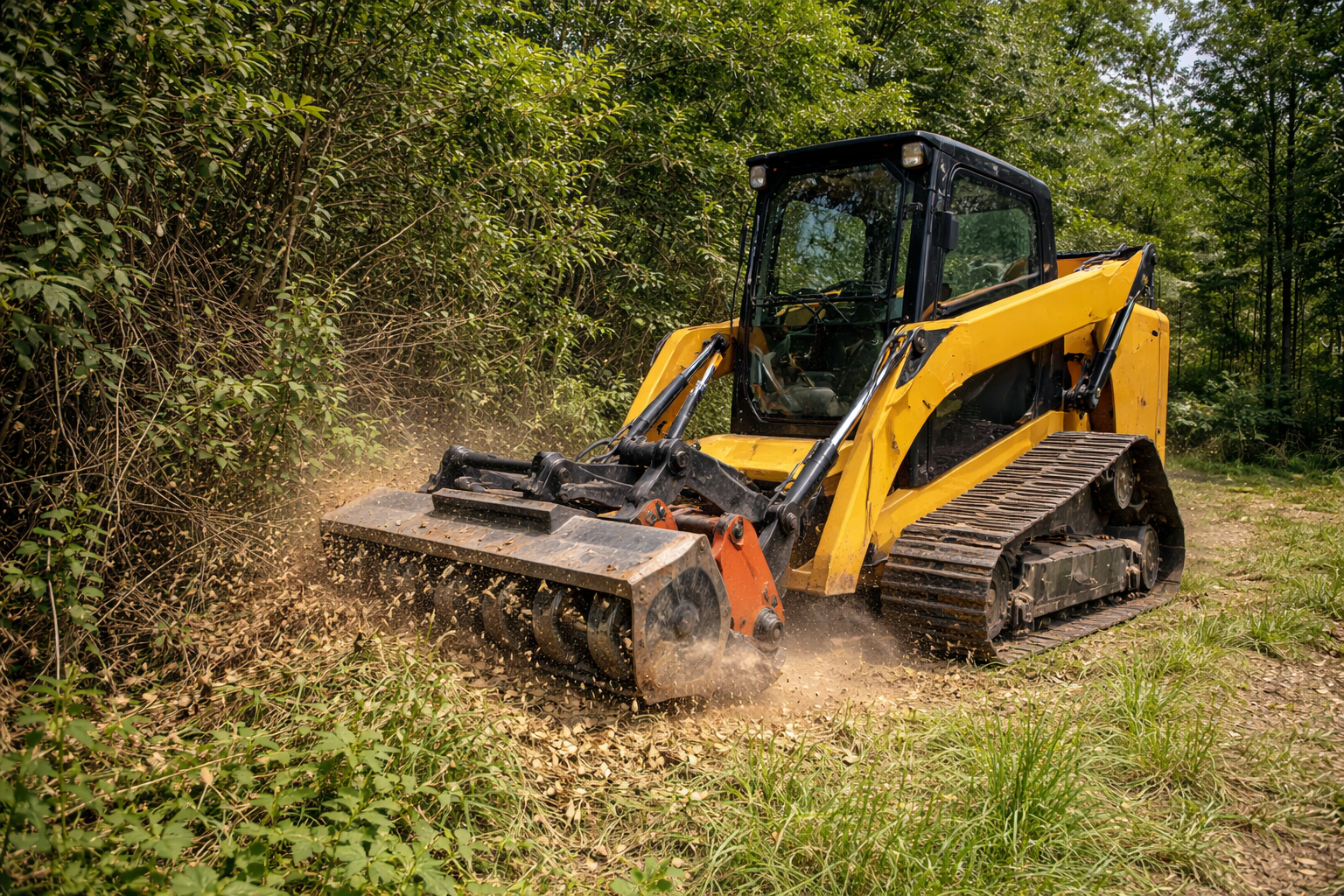
Hyde's Construction brush cutting and drum mulching equipment working on a Southeast Alabama property
Common Project Types

When Drum Mulching Is the Right Fit

Drum mulching handles a wide range of vegetation-management jobs. These are the most common project types where it delivers the best results across Southeast Alabama properties.

01
Overgrown Pasture Reclamation
Pastures that have been idle for several years across the Wiregrass region are often overrun with sweetgum saplings, privet, young pine, and dense briar. A brush hog cannot handle woody growth once stems exceed an inch or two in diameter. Drum mulching grinds these hardwood saplings and their root crowns at ground level, reclaiming grazing land without tearing up the existing sod layer or leaving debris that cattle and equipment have to work around.
02
Residential Lot Preparation
Many home sites in the Enterprise, Ozark, and Dothan growth corridors sit on wooded lots with dense underbrush and scattered mid-size trees. Drum mulching clears the buildable footprint quickly while leaving the surrounding tree line intact. This gives builders a clean starting point for survey and foundation layout, and the mulch left on the cleared area helps control dust and runoff during the construction phase.
03
Fence Line & Property Line Clearing
Fence rows across rural Coffee County and Dale County properties get swallowed by vegetation in just a few growing seasons. Privet, bramble, wax myrtle, and young pine can bury fence wire under layers of growth. Drum mulching restores clean sight lines along property boundaries and opens up access for fence repair or replacement without ripping out the fencing itself. It is one of the most common drum mulching jobs in the area.
04
Access Road & Driveway Right-of-Way
Cutting a new driveway or field road through wooded land requires removing vegetation and creating a clear corridor before gravel or base material goes down. Drum mulching grinds brush and small trees flush to the ground, giving you a clean path that can be graded immediately. On rural properties where long driveways run through timber, this is faster and less destructive than traditional dozer work.
05
Pine Plantation Understory Management
Southeast Alabama has extensive planted pine acreage, and the understory between rows can become choked with hardwood volunteer growth, brush, and briar over time. Drum mulching clears the understory between planted rows without damaging the crop trees, restoring airflow and reducing wildfire fuel load. This type of vegetation management supports both timber value and broader land-clearing goals on managed forestry tracts.
06
Pond Bank & Lake Edge Clearing
Vegetation around farm ponds and lake banks grows aggressively in Alabama’s humid climate. Trees and brush creeping into the waterline block access, reduce usable shoreline, and drop leaf debris that degrades water quality over time. Drum mulching clears overgrowth around pond banks while the mulch layer protects the bank from erosion — an important consideration on pond construction and maintenance projects.
The Process

How Drum Mulching Works

Every drum mulching project follows a straightforward process. Here is what to expect when you work with Hyde’s Construction.

1

Free On-Site Evaluation

DJ Hyde walks the property to assess vegetation type, tree diameter, density, terrain slope, ground conditions, and access points. This determines the right equipment approach and gives you an accurate quote. There is no charge and no obligation for this step — it is the only reliable way to price a mulching job.

2

Equipment Mobilization

A tracked forestry carrier with the drum mulcher attachment is transported to the job site. Tracked machines are critical in Southeast Alabama where soft, clay-heavy soils and uneven terrain can bog down wheeled equipment. The carrier’s low ground pressure minimizes soil compaction and rutting.

3

Mulching Pass

The drum mulcher moves through the target area, grinding standing trees, brush, saplings, and undergrowth into chips and mulch. The rotating drum — fitted with carbide teeth — processes vegetation from top to ground level in a single pass. Small to mid-size trees are taken down and ground on the spot. The processed material falls directly onto the ground surface as a natural mulch layer.

4

Cleanup & Final Pass

After the primary mulching pass, DJ makes a final pass over the site to catch any remaining material, even out mulch distribution, and ensure the finished result is clean and consistent. The property is left accessible and ready for its next use — whether that is grading, building, fencing, planting, or simply improved access and usability.

Advantages

Why Choose Drum Mulching

Compared to traditional push-and-pile clearing, drum mulching offers real advantages for property owners and land managers.

Zero Waste
No Burning or Hauling
All vegetation is processed on-site. No burn piles, no smoke, no hauling trucks, no disposal fees. The debris becomes the ground cover.
Soil Protection
Erosion Protection
The mulch layer shields exposed soil from rain impact and surface runoff — a meaningful advantage on Alabama’s clay-heavy soils where erosion starts quickly once ground cover is removed.
Efficiency
Faster Than Traditional Clearing
A drum mulcher processes standing vegetation in a single pass. No separate felling, piling, loading, or burning steps. For brush-heavy sites, this can cut project time significantly.
Soil Health
Preserves Topsoil
Because the mulcher works from above rather than pushing with a blade, the topsoil layer stays intact. This matters for pasture reclamation, planting, and any land use where soil health is a priority.
Long-Lasting
Suppresses Regrowth
The ground mulch layer blocks sunlight from reaching the soil surface, which slows regrowth of brush and weeds. This gives you a longer-lasting clear result compared to simple brush cutting.
Low Impact
Low Ground Disturbance
Tracked carriers distribute weight across a wide footprint, minimizing rutting and compaction — important on the softer, sandier soils found across parts of Coffee County and the Wiregrass region.
Local Knowledge

Drum Mulching in Southeast Alabama

Drum mulching conditions in Southeast Alabama are shaped by the region’s specific mix of soil types, vegetation, and climate. The Wiregrass area is characterized by sandy loam and clay-based soils that shift in composition depending on proximity to the Choctawhatchee and Pea River drainage systems. Clay soils hold water longer after rain, which affects equipment access and scheduling. Sandy loam sections drain faster but can erode quickly once ground cover is removed — one of the key reasons drum mulching’s built-in ground cover is well suited to this region.

The vegetation that drum mulching handles most frequently in this area includes dense stands of sweetgum, water oak, and loblolly pine saplings; aggressive invasives like Chinese privet and Chinese tallow; wiregrass root systems; blackberry and greenbriar thickets; and wax myrtle. Alabama’s long growing season means that unmanaged land can transition from open ground to dense brush cover in just two to three years. That rapid regrowth cycle is why many Wiregrass-area landowners use drum mulching as a recurring maintenance tool — not just a one-time clearing event.

For properties near creeks, ponds, or mapped drainage features, Alabama Department of Environmental Management stormwater and erosion-control rules may apply depending on the scale of the project and how much land disturbance is involved. Drum mulching’s low ground-disturbance profile can be an advantage in sensitive areas where minimizing soil exposure is a regulatory or practical concern. The Alabama Forestry Commission’s Best Management Practices guide land-management operations across the state and inform how Hyde’s Construction approaches debris handling and ground protection on every site.

Hyde’s Construction is based in Ariton and typically reaches job sites across Coffee County, Dale County, Houston County, Pike County, and Barbour County within 25 to 60 minutes. DJ Hyde provides free on-site estimates and can usually schedule work within a reasonable timeframe after the initial visit.
FAQ

Common Questions About Drum Mulching

Have a question not answered here? Call DJ directly — he picks up and can usually answer on the spot.

Call (334) 432-1473
A drum mulcher typically handles trees up to 6 to 8 inches in diameter efficiently, and some units can process trees up to 10 to 12 inches depending on species and wood density. Softwoods like pine grind faster than hardwoods like oak or sweetgum. For larger timber, the trees are usually felled first and then the mulcher processes the remaining stumps and debris. DJ Hyde assesses tree diameter and density during the site visit to determine the right approach for each property.
Traditional land clearing typically involves pushing trees over with a dozer, piling debris, and then burning or hauling the material off-site. Drum mulching grinds vegetation in place — trees, brush, and stumps are processed into mulch that stays on the ground. This eliminates burn piles, hauling costs, and the bare exposed soil that leads to erosion. The mulch layer left behind protects the soil surface, retains moisture, and breaks down over time. For many Southeast Alabama properties, drum mulching is faster, cleaner, and less disruptive to the land than conventional push-and-pile clearing.
Drum mulching removes above-ground vegetation and grinds surface-level root crowns, which significantly reduces regrowth compared to simply cutting brush at ground level. However, some species — particularly sweetgum, privet, and Chinese tallow — have aggressive root systems that can resprout from deeper roots over time. The mulch layer helps suppress new growth by blocking sunlight, but persistent species may require a follow-up pass or targeted treatment depending on your long-term land-use goals. DJ Hyde can advise on what to expect based on the specific vegetation on your property.
No. One of the primary advantages of drum mulching is that the processed material stays on-site. The ground mulch acts as a natural erosion barrier, retains soil moisture, and decomposes over time to return nutrients to the soil. For most land-management purposes — pasture reclamation, fence line clearing, right-of-way maintenance, or general brush removal — leaving the mulch in place is the preferred approach. If a clean-graded surface is needed for construction, the mulch can be raked or removed as a separate step.
Drum mulching costs vary based on vegetation density, tree diameter, terrain access, and total acreage. Light brush and small saplings cost less per acre than dense hardwood stands with large trees. Most drum mulching projects in the Southeast Alabama area range widely enough that an on-site estimate is the only reliable way to get an accurate number for your specific property. Hyde’s Construction provides free estimates — DJ Hyde will walk your site, assess the vegetation, and give you a straightforward price before any work begins.
Tracked equipment handles soft ground better than wheeled machines, but extremely saturated conditions can still cause rutting and soil compaction. Southeast Alabama’s clay-heavy soils hold water longer after heavy rain, especially in low-lying areas near creeks and drainage basins. If the ground is too soft, it is usually better to wait for conditions to dry out rather than risk damaging the soil structure. DJ Hyde evaluates ground conditions during the site visit and will be straightforward about whether the timing is right or whether waiting a few days will produce a better result.
Drum mulching is an excellent first step for residential lot clearing, especially on wooded properties with heavy underbrush and small to mid-size trees. It removes vegetation quickly and leaves the ground accessible for survey, grading, and foundation work. For lots with large timber that needs to be removed completely — stumps and all — drum mulching is often combined with stump grinding or excavation to achieve a clean, buildable surface. Many homeowners in the Enterprise, Ozark, and Dothan areas use drum mulching as the primary clearing method before handing the site off to their builder.

Ready to Talk About Your Drum Mulching Project?

Tell us what’s growing, how many acres you’re working with, and what you want the land to look like when it’s done. DJ will respond within one business day with a clear, no-obligation plan to get started.